
Google Ads
Module 5.0
Opto Coupled Devices

- After studying this section, you should be able to:
- Describe Different methods of photodiode operation:
- • Photovoltaic.
- • Photoconductive.
- Describe the basic construction of photodiodes.
- Describe the operation of different types of photodiode:
- • Photoconductive diodes.
- • PIN Photodiodes.
- • Avalanche Photodiodes.
- Describe typical limitations in photodiode operation.
- • Dark current.
- • Noise.
- Describe the reason for the choice of common materials used in photodiode construction.
- • Silicon.
- • Germanium.
- • Gallium Arsenide.
- • Indium Gallium Arsenide.
Opto Triacs and Solid State Relays.
Devices that are used in the control of high voltage/high power equipment need to have good electrical insulation between their high voltage output and low voltage input. Relying on a layer of silicon a few atoms thick to provide the required insulation, is not really an option in such conditions. When faults occur (and they are more likely to do so in high power circuits) the results can be catastrophic, not only to the circuit components but also to the users of such equipment. Physical isolation (meaning that there is no electrical connection at all between the input and output) is what is needed. Fortunately there are easy and cheap solutions to this problem. High power circuits are often controlled by "Opto−electronic devices" such as Opto−Triacs, Opto−Thyristors and Solid state relays.
The materials used in the manufacture of Triacs and SCRs, like any semiconductor device, are light sensitive. Their conduction is changed by the presence of light, that´s why they are normally packaged in little chunks of black plastic. However, if a Light Emitting Diode is included within the package that shines its light on a light sensitive semiconductor housed in the same I.C. package, it is possible to control a high power device in response to a very small input current through the LED, without having an electrical connection between the two.
The Opto Triac.

Fig. 5.0.1 Simple lamp control using an opto triac
This is the principle used in Opto−Triacs and opto−SCRs, which are readily available in Integrated circuit (I.C.) form, and do not need very complex circuitry to make them work. Simply provide a small pulse at the right time to the Light Emitting Diode in the package. The light produced by the LED activates the light sensitive properties of the Triac or Thyristor gate and the power is switched on. The isolation between the low power and high power circuits in these optically connected devices is typically several thousand volts.
Solid State Relays
Solid state relay is similar to the opto coupled devices already mentioned, but using power MOSFET transitors as the switching device. Solid State Relays (SSRs) can replace many types of low power electromechanical relays.
It uses opto−coupling to provide complete electrical isolation between its low power input circuit and its high power output circuit. When the output switch is "open" (MOSFETs off) it has a nearly infinite resistance, and a very low resistance when "closed" (MOSFETs conducting heavily). It can also be used to switch either AC or DC currents.
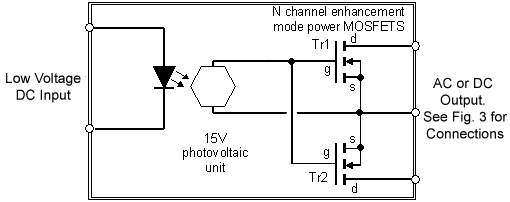
Fig. 5.0.2 The Solid State Relay
A typical circuit of an SSR is shown in Figure 5.0.2. A current of about 20mA through the LED is sufficient to switch on the output MOSFETS. The (infra red) light from the LED falls on the Photovoltaic unit, which comprises 25 silicon diodes. Each diode produces 0.6V to give the 15V gate potential needed to turn on the MOSFETS. Figure 5.0.2 represents a basic example of a SSR, a number of similar SSRs are available to meet different AC and DC output voltage and current requirments, a typical example is the PVT412 SSR from International Rectifier (now part of Infineon Technolgies) manufactured in several versions as a 6 pin DIL package and capable of replacing a single pole mechanical relay to switch AC or DC voltages up to 400V (peak) with currents up to 140mA AC or 210mA DC. Many more complex chips are available that act as double pole, Normally Closed (NC), Normally Open (NO), and Change−over relays with a wide variety of extra facilities. SSRs are also manufactured in a range of output voltages and current ratings, with a range of package types ranging from small surface mount components through complex multi pin chips and large heavy current examples, for rack mounting in electrical control cabinets. Information on SSRs can be found by searching for Solid State Relays on manufacturers websites such as Infineon Technologies or at semiconductor suppliers such as RS Components (opens in a new window)

Fig. 5.0.3 Using a Solid State Relay chip for
switching A.C. or D.C.
Testing opto coupled devices.
The LED in these devices will operate with a forward voltage of between 1V and 2V, the presence of a higher voltage across the LED would indicate an open circuit. LEDs are difficult to test reliably with the diode range of an ohmmeter, since the voltage used is often too low to turn them on. If a correct voltage reading is found across the LED and the output device is not switched on then the IC should be changed. THE WARNINGS APPLYING TO MAINS VOLTAGES ALSO APPLY TO THESE COMPONENTS WHERE THE OUTPUT IS SWITCHING A HIGH VOLTAGE.
ANY WORK ON MAINS POWERED CIRCUITS MUST BE DONE WITH THE MAINS SUPPLY FULLY DISCONNECTED AND ANY CHARGE STORING (e.g. CAPACITORS) COMPONENTS DISCHARGED
If you have not been trained in the safe working pactices that are essential for work on these types of circuit DON'T DO IT! The voltages and currents used in these circuits can kill!